
Why Systems Thinking Isn't Enough
What Deming's System of Profound Knowledge Unlocks


The route to transformation is to understand and apply profound knowledge.
It will not suffice to learn all about the present style of management. One could learn all there is to know about ice, yet know very little about water. [Contributed by Dr. Edward M. Baker]
- Deming. The New Economics. (2nd ed. pp. 123-124, 3rd ed. p. 85)
Transformation produces qualitative differences from the previous state. Relationships that exist in one phase do not exist in other phases. For example, the behavior of a solid can’t be predicted from the behavior of a liquid. Therefore, knowledge of the behavior in one state cannot help to understand and predict behavior in another. A lesson for managers is that the knowledge, skills, and practices that worked in the past will not work as well, and may even be counterproductive, in a qualitatively different future state.
- Edward Martin Baker. The Symphony of Profound Knowledge: W. Edwards Deming’s Score for Leading, Performing, and Living in Concert . iUniverse. Kindle Edition. (loc 709)
THE AIM for this post is to challenge a popular misconception I’ve noticed in articles and blogs presenting systems thinking as a defining skill or capacity that’s missing from the modern manager’s playbook, and this alone will unlock superior capabilities in today’s AI-driven, uncertain world. While learning to see organizations as systems of causal relationships is valuable, it’s insufficient on its own and can lead to frustration when gaps emerge that it cannot adequately explain beyond “it’s the system” — a better theory is required.
Dr. Deming helps us to fill in these gaps with the System of Profound Knowledge, which is what we’re going to revisit today. This will be of particular interest to new subscribers and those just starting their Deming journey.
Operational Definition
Before we get carried away, let’s nail down an operational definition of systems thinking, which I will define very broadly as the perspective of seeing and thinking in terms of the interdependence and interactions of components for a particular purpose. I will bring in Dr. Russel Ackoff here as well to say that in so doing we cannot understand a system through its parts but in how they are put together to accomplish its purpose.
Interestingly, Deming did not make "systems thinking" one of the four domains of profound knowledge. He instead chose the phrase "appreciation for a system," a distinction we'll return to shortly.
Systems Thinking, AI, and Systems Doing
Over the weekend I read two Forbes articles: Today’s Most Crucial Leadership Skill Is Systems Thinking and AI Can’t Fix What Leaders Still See As Tasks: Why Systems Thinking Must Return To Leadership. The former argues that leaders need to adopt systems thinking to cope in a VUCA world (volatility, uncertainty, complexity, and ambiguity) and offers a starter kit of five tools to adopt this newfangled mindset. The latter frames the urgency to become a systems thinker to avoid the pitfalls of naively automating and optimizing system processes with AI and expecting good things to happen.
Each doesn’t offer advice that is wrong per se, just incomplete. Why?
First, because they present a theory that suggests by holding all else constant (ie. the prevailing style of management used almost everywhere), this change in mindset alone will result in better adaptability and successful AI adoptions.
Second, because it fails (ironically) to address the systemic causes driving adoption of a systems thinking view in the first place, ie. the shortcomings of the prevailing style of management.
Third, because buried within the advice is a belief that we can a la carte our way to a better state. Just change your mindset, don’t worry about performance appraisals. On this, Deming was clear that this isn’t going to change much:
Management is in a stable state. Transformation is required to move out of the present state, not mere patchwork on the present style of management.
- The New Economics (2nd ed. p. 123, 3rd ed. p. 85)
So, what are we missing out on when we only look to systems thinking?
Coach Vader and the 97% Untouched Gains
Regular followers and readers will recall this meme I’ve been using for a while of an unnamed person in a Darth Vader costume standing in the surf vainly trying to desalinate the ocean into a 2l bottle with a Brita filter jug. He’s a stand-in for the role I’ve played in my career as an agile software dev team coach trying to teach teams new ways of delivery while holding back the dominant culture of the organization. About as successful.
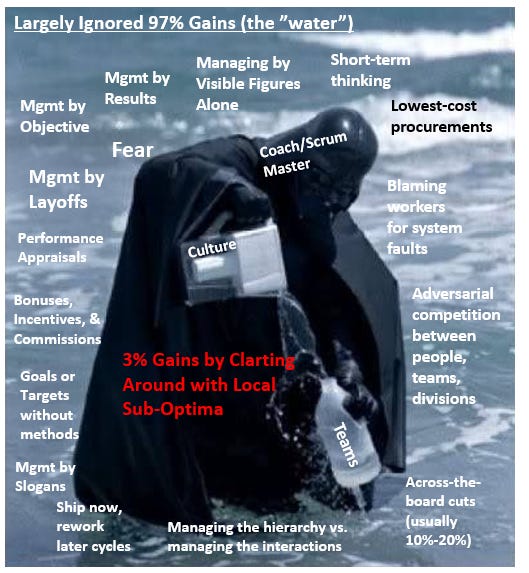
I based this on a table Dr. Deming uses in The New Economics (2nd ed. p. 37, 3rd ed. p. 27) called The Theory for Leadership of the Transformation for illustrating “where we are and what needs to be done”: 3% has been accomplished by improving processes for individuals and teams that produce figures while the 97% high-leverage, big-gains system changes have yet to even be considered.
What Deming’s table doesn’t do that my meme does is show the unceasing futility at changing what people do without changing why they do it in the first place: the overwhelming effects of the prevailing style of management. As Vader diligently and vainly works to filter out the cultural seawater to help the team with new ways to work, the source of the seawater goes unaddressed. This is principally why most transformations face-plant after the coach or executive sponsor departs: the sea of opposing troubles eventually swallows them whole.
Transforming Ice to Water
In my opening quotes I refer to a favorite Deming passage (borrowed from his colleague Dr. Ed Baker, who also contributed the table behind Coach Vader…) that sums up Deming’s view on transformation as a change of state akin to ice and water. It’s insufficient to make better ice when you need to use water: the properties of one do not transfer to the other when a state shift has occurred.
However, Deming was speaking to us as one who had already transformed himself. He used words that while sounding familiar carried totally different meaning because they are used in a different context. What we require is a map or route to get from where we are now to where he is, to shift our thinking state from ice to water…
The System of Profound Knowledge
Dr. Deming provides this to us using a peculiar map to get our thinking aligned with his comprised of four parts:
Appreciation for a System
Knowledge about Variation
Theory of Knowledge
Psychology
Each represents a domain of knowledge that interacts with the others as a system that work together to transform how an individual sees, thinks, acts, and leads within an organization: from ice to water. Here’s another way to visualize them as a diagram from Peter Scholtes’ The Leader’s Handbook — I’ve added color and illustrations, along with Scholtes’ Six New Leadership Competencies that relate to each domain:
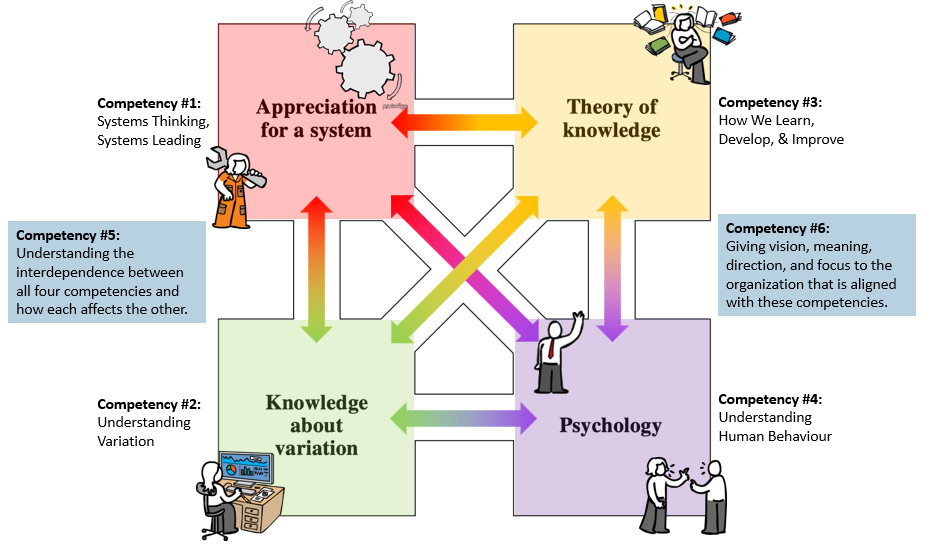
Deming teaches us that you don’t need to be an expert in one or all domains to benefit from applying it - just making an effort to learn and build understanding of the model is sufficient to get started. In this regard, note how the first quadrant is called Appreciation for a System and not Systems Thinking. Deming always chose his words carefully, and here he is lowering the bar to entry: you don’t need to go full Donella Meadows or Russ Ackoff to begin your transformation, you can just start with a simple definition as he provided in Chapter 3: Introduction to a System:
A system is a network of interdependent components that work together to try to accomplish the aim of the system.
A system must have an aim. Without an aim, there is no system.
- The New Economics. (2nd ed. p. 50, 3rd ed. pp. 35-36)
NB: Nothing is preventing you from deepening your expertise in systems if you want, it just isn’t a hard requirement. It’s enough to begin understanding how managing a system differs from managing parts: it’s the interactions between them that matter most.
Your Organization as a System
What the Forbes articles and blogs I’ve read lack is some visual that aspiring managers and leaders could use to help see their organization as a system, to better appreciate how the components are put together and interact with one another. Dr. Deming used a flow diagram to do just that, recommending that you label it with the names of people who do various jobs and how they are accountable to one another for the quality of work they pass along.
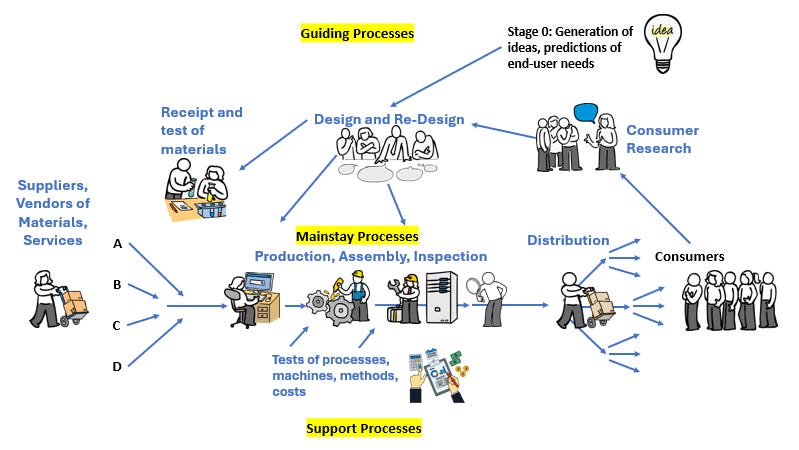
This can be easily adapted to describe any organization’s workflow and to begin surfacing the processes in each stage that govern how something is made for a subsequent process to consume and transform or add value for the customer.
Knowledge About Variation
We’ve covered this in depth here in the newsletter as it’s my favourite domain, but for those new to SoPK, this is understanding that all systems vary in their operation, sometimes by some amount normally (common-cause), and sometimes by some amount extraordinarily (special-cause): good management depends on knowing one from the other. We typically do this with the aid of a Process Behaviour Chart that allows us to sift signals from noisy data. You can create your own with my member-exclusive tool, PBC Analyzer PRO, which teaches you about variation as you use it.
Theory of Knowledge
This domain is all about how we learn through testing our expectations against reality using a theory. Deming teaches:
Knowledge is built on theory. The theory of knowledge teaches us that a statement, if it conveys knowledge, predicts future outcome, with risk of being wrong, and that it fits without failure observations of the past. Rational prediction requires theory and builds knowledge edge through systematic revision and extension of theory based on comparison of prediction with observation.
Deming, The New Economics. (2nd ed. p. 102, 3rd ed p. 69 )
It is rooted in the philosophy of conceptual pragmatism that American philosophy C.I. Lewis developed in the early part of the 20th century, and influenced Dr. Deming’s mentor, Dr. Walter Shewhart. Deming synthesized and refined this philosophy into the Shewhart Cycle that is referred to as a PDSA or Plan-Do-Study-Act/Adjust loop. It is a structured method for making a change to a system guided by theory rather than just shooting from the hip.
An example: Deming teaches us that management in any form is prediction. If a manager decides to introduce an incentive system to improve productivity with “On-the-Spot” awards, they are revealing a theory of management that people are best-motivated by rewards and that the system’s performance can be improved this way. As the program is introduced, the manager gets feedback on whether the prediction is true, including any detrimental downstream effects.
Psychology
This could well be rephrased to “Appreciation for People” or to borrow from lean/TPS: “Respect for People” for the reasons Dr. Deming included it in SoPK. He explains:
Psychology helps us to understand people, interaction between people and circumstances… People are different from one another. A manager of people must be aware of these differences, and use them for the optimization of everybody’s abilities and inclinations. This is not ranking people.
People are born with a need for relationships with other people, and need for love and esteem by others. One is born with a natural inclination to learn. Learning is a source of innovation. One inherits a right to enjoy his work. Good management helps us to nurture and preserve these positive innate attributes of people.
- Deming, The New Economics. (2nd ed. pp. 107-108 , 3rd ed. pp. 73-74)
Incidentally: how many management books have you read that use language like this to describe the necessary behaviours and thinking of managers? I digress…
Knowledge of psychology in the SoPK helps us to appreciate how the common practices of management today destroy self esteem, joy in learning, pride in work, connection between employees and leadership, and ultimately innovation and quality. Effective managers often recognize this intuitively, but SoPK helps to explain why they matter and how organizational systems nurture or destroy them.
Summary and Reflection Questions
I opened this post by observing systems thinking isn’t enough to improve our fortunes because it leaves unaddressed gaps that can frustrate leadership as new circumstances arise. I’ve explained how the System of Profound Knowledge helps to fill those gaps, to help us shift from knowing all there is to know about ice to understanding how to navigate the waters of organizational systems by building knowledge of variation, learning through theory, psychology, and yes, systems. Our challenge is to develop our own sense of mastery in using the model to develop “lenses” to see the world through to transform our thinking and behaviours toward greater abilities to manage for quality and innovation.
Consider my observations about the prevalence of systems thinking as the solution to our present management troubles and my opinion that it doesn’t go far enough to remedy the gaps in our knowledge. Consider further Dr. Deming’s System of Profound Knowledge and its four constituent domains.
Where have you seen systems thinking alone presented as a solution to organizational challenges?
What benefits can systems thinking provide without the additional domains of knowledge in Deming’s SoPK?
How could developing knowledge in systems thinking lead to something SoPK-like?
If you currently use SoPK, which domains do you rely on the most? Least? Why?
What situation have you observed or experienced where knowledge of SoPK domains might have helped prevent a mistake?
If you agree with my thesis that systems thinking is necessary but insufficient, why does SoPK present a more complete model for improving how we lead and manage?
As always, let me know your thoughts in the comments below.



Good post. Thank you for sharing this.
I like the fact that you emphasis being a generalist when in management. I’ve seen too many people bring their specialist expertise or very, very technical expertise into management and then have a hard time understanding why people and equipment aren’t working out properly. We also need to develop the “soft skills” to make things work out.