
Why You Should Read: Demand Side Sales
Bob Moesta Shows How to Bring a Deming/Systems Perspective to Sales

Common sense tells us to reward salesman of the month (the one that sold the most). Actually, he may be doing great harm to the company.
- Dr. W. E. Deming. The New Economics, 2nd Ed (p. 39 ), 3rd Ed (p. 28 )
The transformation will take us into a new method of reward...There will be joy in work, joy in learning. Anyone that enjoys his work is a pleasure to work with. Everyone will win; no losers.
-Ibid. 2nd Ed (p. 123), 3rd Ed (p. 85)
Unfortunately, most salespeople are not taught to think of themselves as a helper. They are taught to think about their product, the what, with all its features and benefits, and the people, the who, as a set of demographics. But they’re missing the five W’s and two H’s—who, what, when, where, why, how, and how much. Salespeople have been trained to only focus on a small portion of the equation. In fact, it seems many salespeople are operating under the marketing framework.
- Bob Moesta. Demand-Side Sales. (p. 193)
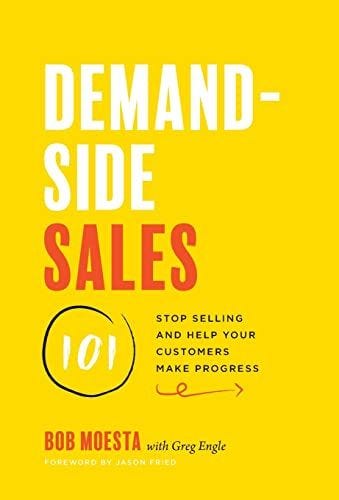
THE AIM for this post is to introduce you to a fantastic book I became aware of a few years ago that brings the philosophy of Dr. W.E. Deming into the world of professional sales with a radical new theory I think he’d appove of: Demand-Side Sales: Stop Selling and Help Your Customers Make Progress by Bob Moesta.
Moesta’s book steps boldly into a void Deming left for us to figure out after eliminating the faulty management practices like commissions and bonuses that caused sales to deteriorate into an “icky” process of pushing products onto customers. His solution is simple but radical: help salespeople who struggle with their work by flipping the entire process on its head and start with the customer, not the product. Shift from supply-side to demand-side thinking. It’s a fresh approach, and if you’re wrestling with how to integrate sales into a Deming-inspired organizational transformation, this book offers a compelling starting point.
Let’s dive in...
Who is Bob Moesta?
Co-founder of the Re-Wired Group, teacher and lecturer at Northwestern Kellogg School of Management and Harvard Business School, as well as an engineer and entrepreneur who has helped launch over 3,500 new products, services, and businesses, Bob Moesta is also a former intern of Dr. W.E. Deming and has worked extensively in Japan with Dr. Genichi Taguchi (he of the loss function curve we’ve discussed before…). Additionally, he worked closely with legendary Harvard Business School professor, Clay Christensen, on the Jobs-to-be-Done theory, which is the foundation for his perspective on selling from the demand-side.
What is Demand-Side Sales?
Put simply, it’s Moesta’s perspective of selling from the customer’s viewpoint rather than the seller’s based on his Jobs-to-be-done theory, which is that people don’t buy products or services, they hire them to make progress in their life, in the “job” it performs for them. A sale doesn’t come from convincing customers of the features and benefits of your stuff by pushing, but in how they convince themselves that their lives will improve by purchasing it.
Moesta says this “pull” toward a solution is generated by a struggling moment the customer wants to overcome, and will convince themselves to buy if they truly believe it will alleviate their frustrations and anxieties. He came to this conclusion by carefully thinking through what causes a sale rather than trying to correlate various factors.
The Struggle is Real: Four Forces of Progress
Moesta identifies four forces that define a customer’s struggle to try something new:
The Push of the Situation: what’s going on in their lives that’s causing them to look for solutions? What are they most concerned about that they want resolved?
The Pull of a New Solution: the realization that they could be better off by choosing a new solution, perhaps bolstered by a friend’s success with it.
The Anxiety of the New Solution: all the ways they can convince themselves the solution won’t live up to expectations, or fail in some way, or lead to profound disappointment, that keep them from making progress.
The Habit of the Present: the inertia of familiarity that keeps them stuck in the status quo. It sucks, but they’ve learned to live with it. The “it is what it is” mentality.
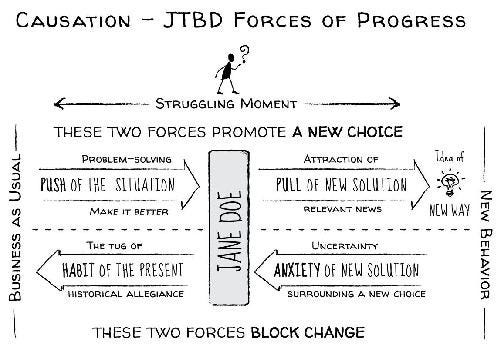
This fits squrely into the domain of Psychology in Deming’s System of Profound Knowledge, and is a fantastic example of how his premier theory of management is still relevant and useful in guiding our thinking about how to improve the quality of solutions we put into the world.
An Example: The Dining Room Table
Moesta relates the story of working for a Detroit-area homebuilder who was looking to improve sales of condominiums with downsizers, predominantly empty-nesters and retirees. In interviews with potential customers, they learned about various motivations that were holding them back, like the logistics of moving itself, and something that surprised them: the dining room table.
Over and over they heard from interviewees about a desire to move that was thwarted by the question of what to do with the primary artefact of every family gathering, birthday, or holiday celebration: the family dining room table. This was something that held a lot of emotional and sentimental value to them, and wasn’t easy to just give away to Goodwill or a deserving niece or nephew — if they’d even take it.
The solution Moesta and his team came up with was to redesign the condo floorplan to reduce the size of the second bedroom and create a purpose-built space for the old table, alleviating the anxiety of what to do with it. The moment they did this, sales jumped 27%.
Another solution Moesta and his team developed by looking from the customer’s perspective was to address their anxieties around how to deal with moving a lifetime’s worth of belongings. They did this by offering a package deal that included movers who would pack, label, and move belongings into a new purpose-built storage facility across the street from the development. This would feature an built-in clubhouse and sorting room where residents could invite family to sort through things at their own leisure. This idea caused sales to jump 22%.
Improving the Quality of Sales
Ultimately, Moesta’s demand-side theory of sales is a hypothesis on how to improve the quality of the process and practice of selling through understanding the way a customer struggles with the decision to “hire” a product or service to help them make progress toward overcoming a problem. By changing the focus from arguing the merits of features and benefits to the customer and toward addressing what is keeping them stuck in their status quo, sales can truly begin to play a part in improving the quality of the products and services they’re called upon to sell. This requires leadership that have a whole-systems view of their operations and how to manage them, with sales as an integral part. The upside could be supercharging their intrinsic motivation and joy in learning by becoming leaders in their own right who serve as mentors and advisors to customers and the organization rather than order-takers.
Why You Should Read This Book
This is a book that has the ability to change the way you think about your thinking about sales, irrespective of whether you’re intending to transform your organization with a Deming view, however, it could very well end up that way. Moesta is up-front with us from the outset that what he is proposing is a new theory. Right at the top of Chapter 1 he makes a direct callback to his mentor with this quote:
Experience by itself teaches nothing… Without theory, experience has no meaning. Without theory, one has no questions to ask. Hence, without theory, there is no learning.
- Dr. W.E. Deming, The New Economics.
Demand-Side Sales, like Deming’s The New Economics before it, is a book describing a theory for reinventing the sales process that has come from careful observation of what’s wrong with the prevailing way we think about sales, as an “icky” process of pushing a product or service on to a customer, and proposes a better way from understanding the psychology of how people convince themselves toward a tipping point. Understand this struggle and how to tailor your offerings to help people make progress through it and they will beat a proverbial path to your door. This is very much in alignment with what Deming said about quality in The New Economics:
A product or a service possesses quality if it helps somebody and enjoys a good and sustainable market.
2nd Ed (p. ), 3rd Ed (p. )
Demand-side sales is the logical antecedent to this: it is the way to get a quality product or service into a customer’s hands that fits right into Deming’s diagram of “Production Viewed as a System”:
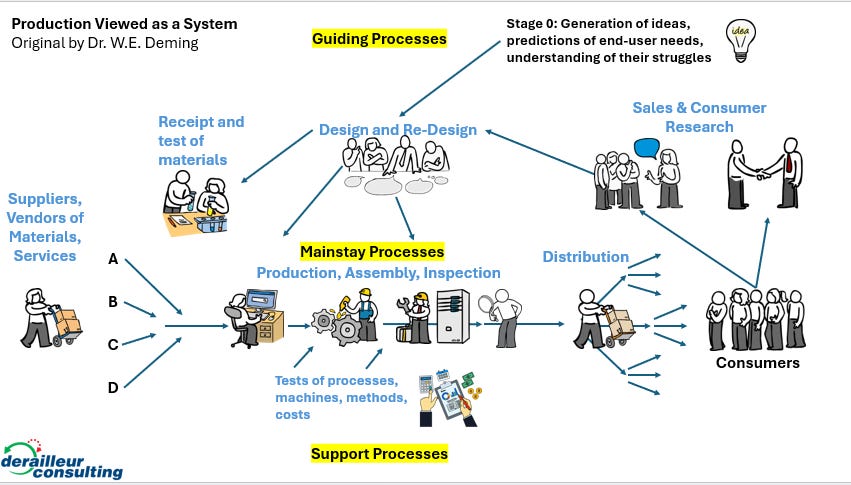
Of course, Moesta goes into more detail in his book about how to do this beyond what I’ve laid out above and it’s well-worth the investment to learn from his experience. Couple it with a subscription to his Re-Wired Group newsletter (see below) and you have a wealth of wisdom and knowledge that can be applied to improvement of quality.
Dr. Deming observed that the prevailing style of management causes sales staff to aggressively compete with one another for commissions, bonuses, and awards — often to the detriment of customers and the company itself. It would be better to eliminate those things, he argued, and work together as system with the aim for everyone to win: managers, customers, employees, suppliers, and vendors. With Demand-Side Sales, Moesta offers just such a way, and it is definitely why you should read this book.
Reflection Questions
Consider the brief teaser of Demand-Side Sales I’ve explored above. What products or services do you “hire” or are considering to “hire”? What motivated your decision? Does it fit with Moesta’s theory?
If you were to redesign how you currently sell a product or service to a customer from the demand-side, what could you do? What would be the necessary pre-conditions for sales to participate? Do you use demand-side thinking right now? How so?
What struggles are your customers wrestling with right now? Is there a feedback loop to direct this into the design and re-design of your products and services? What simple experiment (PDSA) could you devise to gain this knowledge?
How could you apply Jobs-to-be-Done (JBDT) theory within your organization? What experiment could you try to gain knowledge?
Let me know your thoughts in the comments below…
Further Recommended Reading
The Rewired Group: This is the company Bob Moesta co-founded with Greg Engle in 2009 to help customers launch new products and services. They have a newsletter you can sign-up for (at the bottom of the homepage) that gets delivered to your inbox chock-full of wisdom and is well worth the price (FREE) to read. Do it.
Founding Subscriber Eric Budd at Institute for Quality and Innovation uses Jobs-to-be-Done theory extensively in the Deming Management Theory courses he offers that challenge students to think through understanding the chain of interactions across an organization to reach a customer. Contact him for more information and how to register for classes.




One of the definitions of quality that Dr. Deming left with us begins, "A product or service possesses quality if it helps somebody." Job-to-be-done (JTBD) theory fulfills the gap that gets created when we ask, "How can we ensure our product or service is helping?"
In the IQI Academy, we help people practice application of JTBD theory with a Chain-of-Customers exercise adapted from Brian Joiner. [Me -> Direct customer of my outputs -> Direct customers' customer -> and so on.] Almost no one who attempts to complete the 5-position exercise form can do so without needing to interview people in their chain-of-customers.
Dr. Deming described a system of production this way, "“Everybody at work in any pursuit, any endeavor, be it building, education, Post Office, transportation, manufacturing, service of any kind, has a customer. Somebody takes their work and does something with it. There is a chain of production.”
When we realize that is it the next person or department who must do something with our outputs and that they also have a "next person" by whom their output is being put to use, we begin to see that each person in the chain has a unique Job-to-be-Done.
If we want to "help somebody" with our work, we can do so by learning to better address each Job-to-be-Done in our personal and organizational Chains of Customers.
I am quite sure W. Edwards Deming would have advocated this view:
https://nielspflaeging.substack.com/p/sales-departments-should-never-have