
Rethinking Deming's Introduction to Japan
A Guest Post from Senior Deming Community Contributor Dave Nave


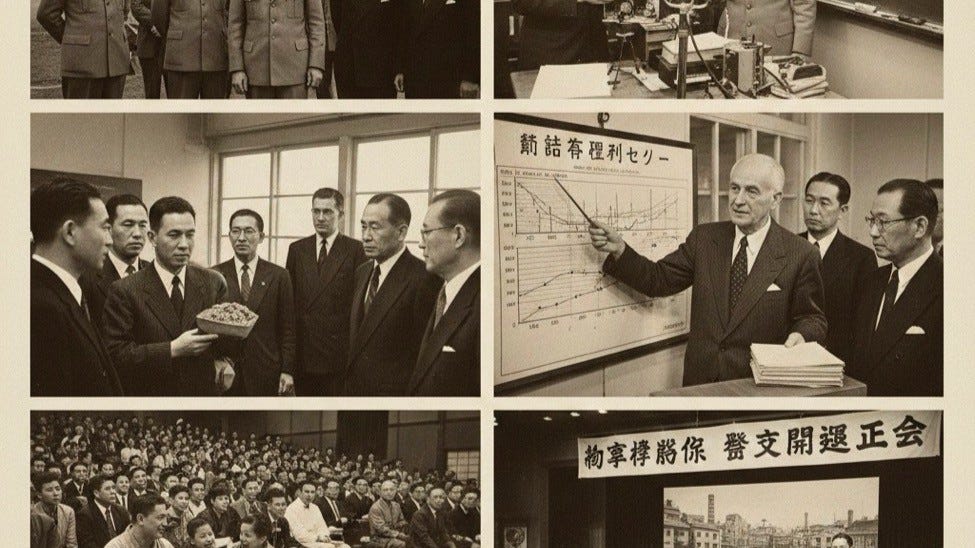
Editor: Below is an article long-time Deming community contributor and management consultant, Dave Nave, published on LinkedIn earlier this month and has graciously granted permission for me to share with all of you. Within, he tells a story of Japan’s post-war turnaround as a complex meeting of the right people at the right time with the right understanding of what to do and how to set about doing it. Dr. Deming is often given top-billing here, but there were others who made significant contributions of their own including Homer Sarasohn, Charles Protzman, and Dr. Joseph Juran. Enjoy!
CRC.
Over the years, many misconceptions have grown around Dr. W. Edwards Deming’s introduction to Japan in 1950. The popular narrative often portrays Deming as a lone figure who transformed Japanese industry overnight. The reality is more complex, more human, and ultimately more interesting. What follows is a summary of what I’ve learned about how Deming’s work fit into the broader context of postwar Japan.
After World War II, President Harry Truman appointed General Douglas MacArthur as Supreme Commander of the Allied Powers, responsible for overseeing the occupation of Japan. Truman gave MacArthur explicit instructions not to interfere with Japan’s economy. The focus was on demilitarization and stabilization, not economic reconstruction.
That position quickly became impractical. MacArthur needed a way to communicate with the Japanese people, and radio was the most effective medium. Yet most industrial plants had been destroyed during the war, making radio production nearly impossible. Faced with this challenge, MacArthur concluded that the Allies would have to help rebuild Japan’s industrial capacity—whether that was part of the original mandate or not.
Complicating matters further was the structure of Japan’s industry. The keiretsu-style system, with its tightly interconnected business groups, proved difficult for the occupying forces to navigate. MacArthur ultimately dismissed Japanese industrial executives and replaced them with middle managers. While technically competent, these new leaders lacked experience in running entire enterprises.
To address this gap, Homer Sarasohn and Charles Protzman developed a course titled The Fundamentals of Industrial Management. This program was delivered to the new Japanese company heads through the Allied Civil Communications Section (CCS). The goal was not optimization or innovation, but basic managerial literacy—how to run an organization at all.
As 1950 approached, another need emerged: conducting a national census of Japan. The Allied Powers turned to Walter Shewhart for help with the statistical aspects of data collection. Shewhart was unable to contribute directly, but he recommended several alternatives, including Dr. W. Edwards Deming. He was consulting in India and agreed to assist. Charles Protzman, already familiar with Deming’s work in statistics, supported the recommendation.
While in Japan working on the census, Deming met with senior Japanese industrial leaders. He emphasized a message that would later become famous: Japan’s economic future depended on quality and market research. Initially, his audience was skeptical. The idea that quality—rather than volume or cost—could drive national recovery seemed abstract and unconvincing.
That changed when an engineer applied Deming’s statistical teachings to a practical problem: measuring the iron content in a shipment of ore. The improved measurement accuracy led to significant cost savings. This tangible result captured the attention of Japanese business leaders. Interest grew—not in Deming as a personality, but in the methods that produced such outcomes.
As a result, Deming began conducting seminars on statistical management in industry. These sessions laid the groundwork for a different way of thinking about work, variation, and decision-making. Importantly, Deming donated the rights to his lecture notes to the Union of Japanese Scientists and Engineers (JUSE). The proceeds helped fund Japan’s efforts to revitalize its economy and reduce waste through improved quality.
In the years that followed, others contributed to this emerging movement. During the 1950s, Joseph Juran delivered lectures that focused more explicitly on managing quality and integrating it into overall business strategy. Together, these ideas gradually reshaped Japanese management—not as a single intervention, but as an evolving system of thought.
There are also several lesser-known details that help humanize this history. MacArthur, Sarasohn, Protzman, and Deming are not primarily remembered for their original missions to Japan, but for what they chose to do once they arrived. Homer Sarasohn, for example, paid a local family to let him live with them so he could better understand the Japanese language and culture. Deming, for his part, attended many Japanese NOH —guided by a mentor in Washington, DC—to learn more about the culture.
These actions reflect a deeper truth about what ultimately mattered. The transformation of Japanese industry was not the result of a single theory or heroic figure. It emerged from context, curiosity, cultural respect, and practical learning. Deming’s contribution was significant, but it succeeded because it was timely, grounded, and embraced by people willing to experiment and learn.
Understanding this fuller story helps move us beyond myth—and closer to the real lessons that still matter today.
 | A guest post by
|
As I mentioned in the comments to Dave's original post, there is an alternative, citable evidence that contradicts this version, which I have highlighted in my book on Deming. While Dave's knowledge of Deming is unprecedented, I have citations that point out some inconsistencies in this account. As for who's right, I have no clue...