

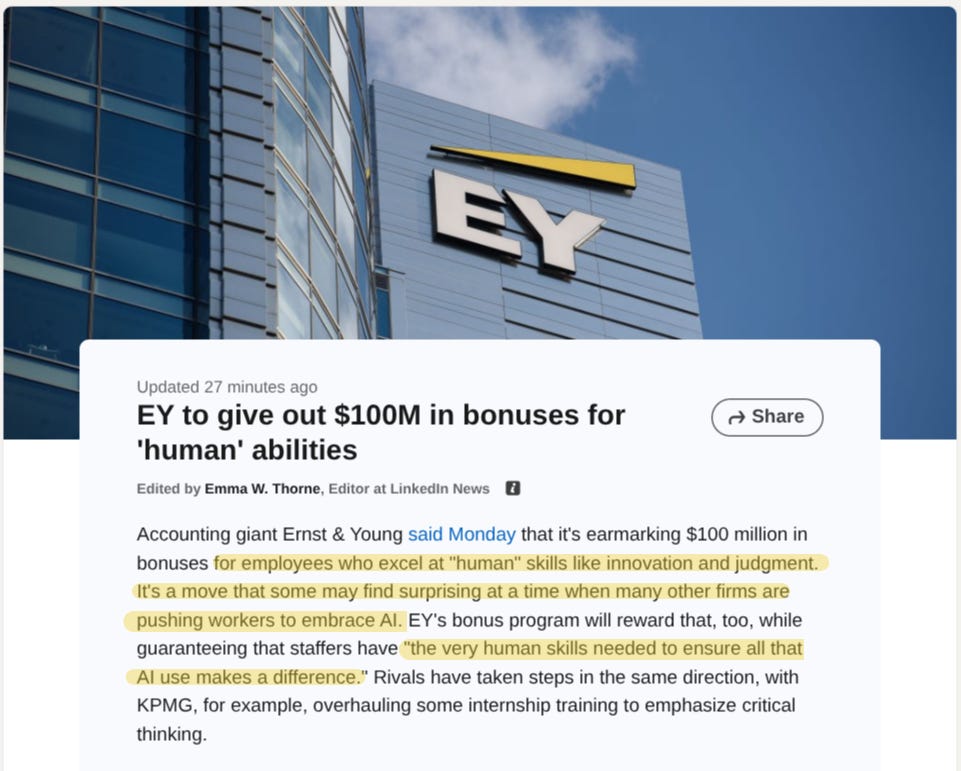
THE AIM for today’s newsletter was inspired by the above-captured story I came across on LinkedIn about mega-consultancy, Ernst & Young, latest use of the world’s oldest (and worst) method of corralling the cats in an organization: the bonus. However, this time instead of using this blunt instrument to drive Q4 revenue targets, they are hoping to direct their staff to exercise more human behaviours like “skill” and “judgment” in pursuit of “innovation”— while simultaneously embracing a technology that pulls them in the opposite direction to delegate these things, AI.
We’ve explored the topic of using extrinsic motivators like bonuses to drive behaviours in past newsletters, but I thought it useful to return for another look in this case because of the tension that this move is going to put on employees as they now have to decide how to embrace AI while disavowing it for old fashioned human intuition and skill. The post also indicates this is a trend among E&Y’s peers like KPMG, giving us a window into how the prevailing style of management that Dr. Deming continually warned about is reinforced and spread through FOMO (fear of missing out).
A short review of why this is a bad idea with a time fuse…
411: What is E&Y Actually Doing?
According to reports, E&Y leadership have earmarked $100M USD this fiscal year to reward employees who demonstrate “adaptability, innovation, and judgment” with $500 spot awards and $10k-$25k for teams, which also includes using AI in the process. One outlet suggests that they already sense the trap they’ve set for themselves by trying to avoid using the word “tokenmaxxing” or using AI token spending as a proxy for productivity.
In effect E&Y have set two opposing forces at play within their untouched prevailing system of management: use AI to boost productivity while simultaneously exercising judgment on when and how to use it, with winners and losers arbitrarily decided by managers who will no doubt be measured on how they use the spot and team awards with discretion. What fun.
The Bonus Problem: Money Motivates Those Who Excel in the System
A short anecdote from one of my past engagements that I’ve told here before, but I’ll briefly re-share to set us up. A while ago, I was invited to present a workshop at a company offsite at a large restaurant/bar downtown. It was the kind of place where the tables and lounge were separated by a partition, in this case an exposed brick wall that extended to the rafters in this trendy converted factory space. After I’d set myself up on the tables side, I walked over to the lounge side to mingle with the staff who were in a commotion.
Apparently, moments before I arrived, the CEO had set up a fun contest for the employees — spur of the moment. He placed a $20 bill into a crevice in the exposed brick wall that divided the two spaces, about seven or eight feet from the floor. First person to reach the bill got to keep it. By the time I entered the lounge the contest was over and there was a weird energy to the room with one side jubilant and the other not so much. After asking around about what happened, I learned about the game from an excited young guy.
“Who won?”, I asked him. “Oh, it was so-and-so, he used to play college ball!”, he enthusiastically replied while pointing at this 6’ 5” giant on the other side of the room who was getting back-slaps from his peers. “He just ran up the wall and snatched it!”
“Wow, that’s really something,” I replied. “What did you learn from that?”
“MONEY TALKS!”, he exclaimed, completely oblivious to the nature of the game.
As I looked around the room, my eyes settled on a diminutive woman of about 5’ in height who wasn’t looking dejected among the hubbub, but was rather in a bemused form of resignation. I asked my enthusiastic new friend what she might have thought of the game, and he just shrugged and walked over to the giant.
The moral of the story is that money is a motivator, but it is a dumb form of motivation that only rewards individuals whose skills, capabilities, and immutable characteristics mesh well with the system they work within. Accordingly, it also demotivates those who cannot, as well as dis-incentivizes those who want to improve the system. Per Deming:
The idea of merit rating is alluring. The sound of the words captivates the imagination: pay for what you get; get what you pay for; motivate people to do their best, for their own good.
The effect is exactly the opposite of what the words promise. Everyone propels himself forward, or tries to, for his own good, on his own life preserver. The organization is the loser.
Merit rating [bonuses] rewards people that do well in the system. It does not reward attempts to improve the system. Don’t rock the boat.
Out of the Crisis (p. 102)
Additionally, it destroys teamwork and cohesion between colleagues. Ever wonder why it is so taboo to know who’s getting paid what base salary and bonuses? That would pull back the curtain too far, it’s argued, and lead to suspicions and jealousies that erode camaraderie. Ironic.
In any event, E&Y leadership have created a game of Mousetrap where certain players, like the giant, will succeed and get the $500 bonus because they arrive at an innovative solution to satisfy both constraints, and it won’t necessarily improve anything for a customer or the organization. Meanwhile, there will be many losers who actually do try to improve things for a customer that will get the stick in lieu of the carrot.
Field Notes: A Well-Intended Manager’s Folly
One more short story from my experience as a coach: I was working with a senior level manager who was having difficulty getting her staff to do rotations on support duty — nobody enjoyed it, so it was actively avoided with sick days and apologies about being too busy. So, she came up with a solution: on-the-spot awards for those who take a shift in the form of a $25 Amazon Gift Card.
When she told me about this, I looked on in disbelief, but she was adamant to try it first and see if things improved.
As the program rolled along, she began to notice that one individual was on support more than anyone else. She discovered that they were cleverly taking other people’s support shifts in exchange for their on-the-spot award. When discovered, they had a fat stack of cards.
We had a “what did we learn” conversation afterwards, all good-natured…
Tensegrity
I opened this post by highlighting how E&Y is going to use the oldest trick in the book, money, to direct their employees to: 1) Use AI, and; 2) Use their skill and judgment in using AI. This raises the obvious question of why you need to use money to do this; to paraphrase Peter Scholtes, did you hire dumb people, or did you hire smart people and make them dumb? This might sound flippant, but incentives do just this: they make smart people incredibly dumb.
The problem E&Y management have is that they are giving conflicting rewards that will push and pull people on when to use AI in their work. It’s a form of tensegrity, a portmanteau of tension and integrity that was coined by American architect and system theorist Buckminster Fuller to describe a stable system where the components are simultaneously under tension and compression, each holding the other in stasis. The video below shows an example of this effect using LEGO:
In E&Y’s case, their policy is similarly holding their employees in stasis by reinforcing the only good move is one that pursues a metric or reward. On the one hand, use AI! On the other, use your judgment! In either case, rationalize why you chose one or the other! And by the way, it was never about your performance in the first place so it could all come down to a confluence of factors well beyond your control. This can lead to some unintended consequences…
E&Y’s Kobayashi Maru Situation
In the 1982 movie, Star Trek II: Wrath of Khan, we learn the history of central character Captain James T. Kirk who, in his youth at Starfleet Academy solves an impossible no-win training scenario involving a disabled civilian vessel, the Kobayashi Maru, that drifts into enemy controlled territory. The options given are to rescue the passengers, which could trigger a war, or to destroy the vessel killing all on board. In the fiction, it was designed to test the command capabilities of cadets to make the best decision under the worst circumstances, with a loss either way. Over time, it’s become shorthand for analogous no-win situations where you’re damned if you do, damned if you don’t. Here are some I’ve come up with that E&Y employees could find themselves battling their consciences within:
Scenario 1: Using AI to catch mistakes that hurt your numbers
An associate runs a client deliverable through an AI tool that returns results quickly, but on examination doesn’t sit right. So, they dig-in to the details and make in-situ fixes, thinking this meets the criteria for using human judgment and could net the team $10k++. However, at the same time, this tanks their annual commitments on turnaround times which was the whole point of using AI in the first place. They could just let the mistakes slide and no-one’s the wiser, but that hurts the credibility of the team when it’s discovered downstream.
Scenario 2: Manufacturing a crisis
This one is a take on the classic scenario of the organizational arsonist/firefighter, where crisis management is an in-demand and well-rewarded skill that eventually creates its own demand with employees setting fires to put out. In this case, by incentivizing what should be a professional norm you actively train people to perform rather than act.
For example, a clever player of this game might let some things “unintentionally” slide that could cause a big client significant pain, only to visibly rescue them later with AI at the last minute, or craft a scenario that leads with an AI-driven solution that has a fatal flaw only to be uncovered at the right time by exercising human adaptability, innovation, and judgment.
Scenario 3: The client-facing contradiction
Like many consultancies, E&Y’s pitch to customers has been using AI to be more effective and efficient, and this has been borne out with 2025 AI-related revenue up 30% on an annual basis. However, this also conflicts with having a human professional standing behind every audited figure. In this scenario, an engagement team is quietly asked to look like they are lean and AI-leveraged to the client while being slow enough to survive an inquiry if things go pear-shaped. Fast-and-confident or slow-and-skeptical. Both held in stasis, both awardable.
Common to each is that while the employees may be flirting with unethical behaviour, they would be acting rationally toward the system they are in and the incentives they are provided (Leadership Cheat Code #5). It’s all a game.
Rx? Reprogram the Simulation
So, how did the young James T. Kirk solve his unwinnable Kobayashi Maru test? By reprogramming the simulation.
As the fiction goes, during his court martial he defended his actions by stating he rejects the premise of being subjected to a test where the outcome is to always accept a predetermined loss one way or the other. Changing the rules of the simulation changed the behaviours and made it winnable.
In the much the same way this is precisely what Dr. Deming invites all of us “living under the prevailing style of management” to do: to step outside of it and reprogram our thinking to reject the “huge losses” of faulty, pre-determined practices (The New Economics, Ch. 2) and adopt a view that makes winning, over the long-term, permissible for everyone. Deming called the route to this transformed state the System of Profound Knowledge, which we’ve covered in prior newsletters as “new” leadership competencies — I encourage you to read-up on them to get a better sense of what they entail:

For E&Y leadership, reprogramming their simulation would mean categorically disavowing the use of bonuses to manipulate employee behaviour toward professional practices and instead look at why they think they need to do so in the first place. Ask: how did we design a system of incentives that led us to the point where we believed $100M in more incentives would fix an emerging problem in how we use AI for our customers? Moreover, have we thought about what happens when the program ends?
Reflection Questions
Consider E&Y’s fated foray into using $100M to incentivize their staff to adopt professional behaviours when using AI, and how it can hold them in a state of tension and compression (tensegrity) where they ultimately decide to act rationally toward the system they are within and play the game to win the prize. Have you seen or been part of a similar circumstance in your experience? Did you play the game? Did you “win” ? What were the downstream consequences? How long did the program last? Is it still used today or was it quietly abandoned? Why? What took its place?
Given what’s been discussed, what would you do under similar circumstances? What would you recommend to managers and directors about how to play the game?
I’d be fascinated to hear about your thoughts and experiences in the comments below…

An excellent post. Thank you for sharing.