
Are Deming-Led Organizations Better Able to Take Advantage of AI?
How Better Theory Better-Prepares Leadership for Sensible Adoptions

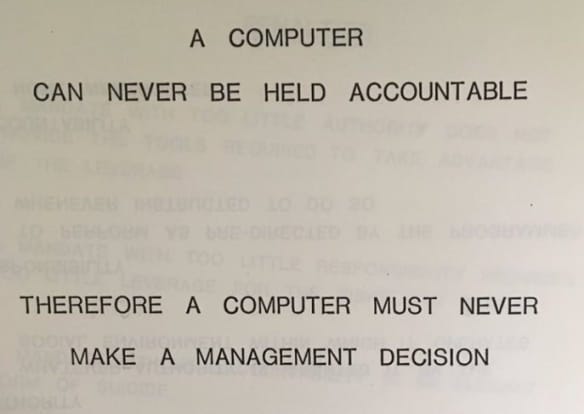
THE AIM for this post is to propose a hypothesis: that an organization led by leadership who think and act with a Deming perspective, one that is actively working to improve their systems and processes according to his teachings, is in the best possible position to sensibly adopt and benefit from AI than any of their Old Economics peers.
Sensible adoption means something specific: deploying AI solutions where scaled process automation genuinely improves the quality of products and services, while freeing people to apply their talents and creativity to problems that benefit customers over the long run, rather than as a means to eliminate headcount and optimize for costs.
In a recent post, The Four Horsemen of the Coming Layoffs Apocalypse, I wrote about how AI is supercharging the worst instincts of management that Deming identifies in The New Economics. Here I ask: What would a sensible AI adoption look like inside a Deming-led organization? How would it differ? Why?
Grab a cup of your best joe and let’s dive in...
tl;dr
For the impatient, we look at how AI adoption goes wrong when guided by the theory of the prevailing style of management, and how it can lead to expensive failures like those experienced by Klarna and Microsoft Copilot. I frame this using three key stages of AI adoption that industry commentator Nate B. Jones relates in a recent video and how poor outcomes are almost guaranteed given inconsistencies in how information is structured and captured.
What is the AIM for Adopting AI?
Deming teaches us that “management in any form is prediction,” and in most AI adoptions under the prevailing style of management we see leadership predicting lower costs, higher customer satisfaction, and profits to match. Reality? Not so much.
In a video from earlier this year, AI commentator Nate B. Jones tells the story of two failed AI rollouts, payment processor Klarna and Microsoft Copilot, to illustrate the readiness problem organizations are facing, and how a naive adoption driven by poor assumptions can lead to expensive disasters.
For example, Klarna’s CEO found out the hard way when he replaced ~700 customer service reps with AI agents to improve resolution times. What followed was MBO on steroids: turnarounds dropped from 11 minutes to 2 while simultaneously increasing complaints. Suddenly, a projected $40-$60M in savings turned into a loss of unknown and unknowable proportions as loyal customers were alienated and future prospects turned off. By mid-year, the CEO admitted “cost was a predominant evaluation factor, but the result was lower quality.” Perhaps too late, Klarna scrambled to re-hire the laid-off humans.
Jones suggests that the bots didn’t fail, but dutifully met their goal. What was missing from the agent’s knowledge was Klarna’s intent to build lasting customer relationships to last a lifetime in a highly competitive market. Ironically, it might have tipped leadership’s hand on what they actually valued more: saving money.
When unguided by good theory, it’s easy to see how the CEO could be misled into believing short service calls across-the-board lead to lifelong customer relationships: the wrong things get prioritized and translated into errors of omission for the agents. Deming warned that people will do almost anything to meet a target or goal, even at the expense of the system: AI makes achieving this kind of destruction at scale extremely easy.
Why Most Organizations Aren’t Ready
Jones frames the evolution of AI engineering into three stages: prompt engineering (”how do I talk to AI?”), context engineering (”what does AI need to know?”), and intent engineering (”what does AI want?”). Most organizations stall at the second stage because their knowledge is locked in silos, scattered across systems, and living in people’s heads rather than documented in a way agents can consume. Without that foundation, intent engineering isn’t a next step; it’s a pipe dream.
Microsoft Copilot is the proof of concept. Despite billions invested and 85% Fortune 500 adoption, only a small fraction of organizations moved from pilot to meaningful deployment. Jones rejects the standard explanation (poor UX, weak model quality) and instead names it for what it is: deploying AI without organizational intent alignment is like hiring tens of thousands of new employees and never telling them what the company does, what it values, or how to make decisions. You get activity. You don’t get productivity.
Jones names three root causes underneath all of this:
Organizations don’t have consistent, explicitly documented values (incoherence);
The people who build agents and the people who set strategy don’t talk to each other (two cultures)
Most leadership teams have never had to make their intent explicit and structured before (fundamental difficulty).
None of this is a technology problem. It’s a management problem.
Which is where the good Dr. Deming comes in.
Let me explain…
